
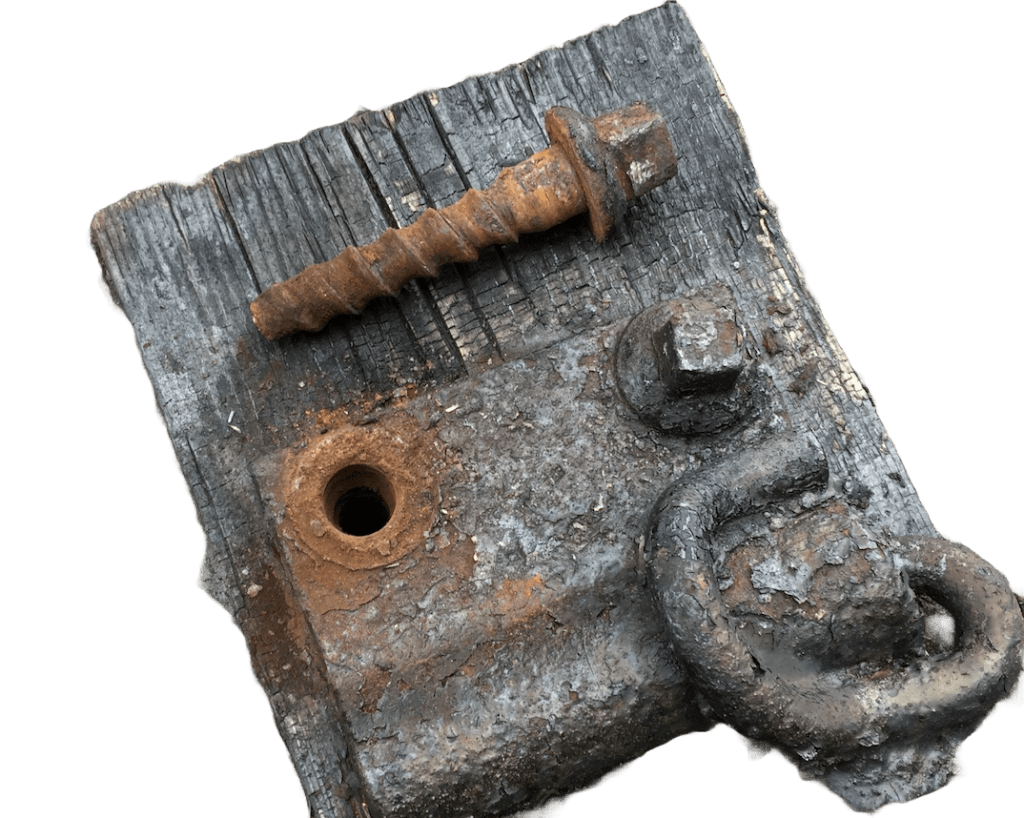
A sleeper ‘screw spike’, disinterred, despite its best efforts, during the restoration of the Sliverdale Mining Memorial.
Aristotle’s three laws of thought are the logical axioms by which all inference is justified, and to which all deduction is reducible. That is to say, every rational thought, scientific discovery, and computer programme, ever, has been underwritten by these Athenian maxims. The third of these is the Law of Identity, which can be expressed as ‘For all a: a = a’. Or ‘everything is identical to itself’, from which we yield the converse principle, Leibniz’s law: ‘no two distinct things can exactly resemble one another’.
Every now and then we encounter the collapse of a concept that seems so every day, so pedestrian, that it should be immune from the abstruse sicknesses of philosophical ambiguity and mathematical paradox. These little concepts are the furniture of our minds; they allow us to file away ideas, arrange experiences into ornamental decoration, and settle down comfortably on a well-worn belief.
So imagine my shock when – having concluded an earnest description of a particular bolt required for the mounting of a Gormley sculpture – the disgruntled ironmonger shot back: “Well that’ll be a cap ‘ed screw you want then, won’t it?”, hauling his considerable bulk from the unflattering arse-up posture he had adopted to scrabble around at the behest of my deficient classification. Not knowing what the hell a cap head screw was, I reiterated my description of the desired bolt. In response, he reached for a more accessible drawer and produced a straight-shafted and blunt-tipped fixing, before sullenly slapping it onto the counter. “Cap ‘ed screw”. My head spun as I tripped over my description once more, all the while suffering from a rush of utter confusion and sense of inadequacy. I thought screws were sharp and tapered, and bolts were blunt and straight. Yet the fastener before me was patently blunt, but also a screw? But wait, machine screws are blunt, and come to think of it, lag bolts are pointed. So what is the distinction here? For five years, I’ve been deploying these terms with a confidence now revealed to be completely ill-founded. How could I have misapprehended such elementary categories? How many times had I made these foolish semantic slip-ups? For the third time, his oily hands plunged into a draw, on this occasion producing “Coun’er-sunk socket screws”. That was them. He was right all along; it was a screw that I sought.
After a sheepish exit and with the hard-won fasteners safely tucked in my pocket, I hopped on my bike and headed back to the workshop. Meditating upon the subject, I toiled at the different metrics by which screws and bolts could be differentiated; surely bolts must be received by an internally threaded material (or a nut), whereas screws cut their own thread? But no, this was a simple reformulation of the blunt versus tapered rule. Most bolts are torqued from the external edges of their heads, and most screws have a shape cut into their heads to receive a bit, but coach screws have hex heads and carriage bolts can’t be torqued at all. I was mystified.
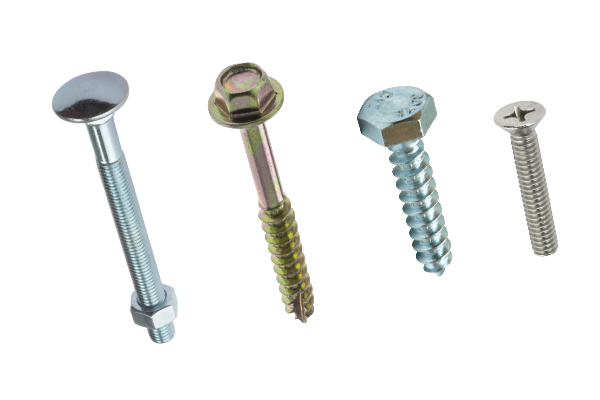
A carriage bolt, a coach screw, a lag bolt, and a machine screw, respectively. I defy anyone to rationalise the taxonomical conventions at play here.
With my attempts to draw the veteran conservators on an answer by way of clumsy, oblique questioning proving unsuccessful, I left the workshop none the wiser than when I had entered it. So, I spent the evening in a helical spiral down into the depths of the internet, researching all things fastening. As it turns out, I am not the only one to have been beguiled by the screw-bolt dilemma, and it has been the source of many a lively online spat. Boring through DIY videos and woodworker tutorials on YouTube, endless ironmongery catalogues, and etymology message boards, I punched through the plasterboard of the internet to … relief – not a cavity – but the satisfying thud of substrate: The US Customs and Border Protection’s informed compliance publication Distinguishing Bolts from Screws, a scintillating read. The 21 pages’ promise to “identify an externally threaded fastener as a bolt or as a screw” boils down to bolts being “intended to be tightened … by torquing a nut”; screws being capable of “mating with a preformed internal thread or forming its own thread”; and the disclaimer that “it is possible to use certain types of screws in combination with a nut”. So screws can be bolts, and bolts can be screws, depending on how you choose to use them. And for that matter, is a captive nut a preformed internal thread? I’m not sure what conceptual clarity I expected to gain from the US Department of Homeland Security, but to borrow some of their own vernacular – screw you guys. Next time, I’ll ask for an externally threaded fastener.
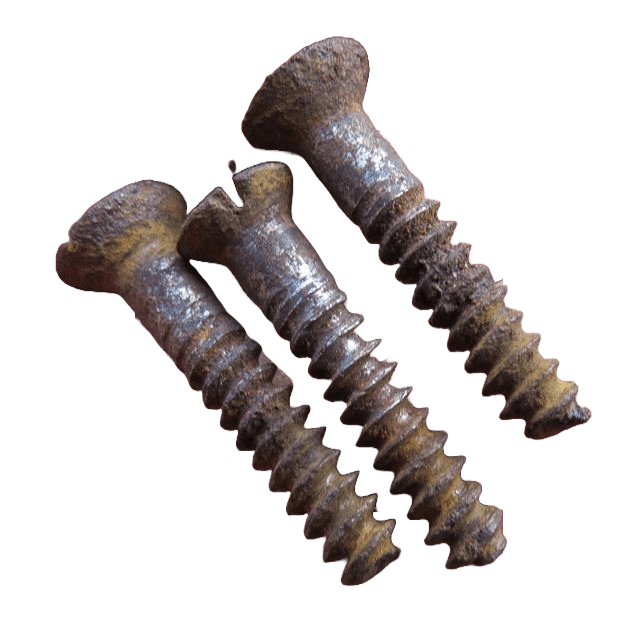
A final irony: the hand-fashioned screws of the 17th Century and earlier, that pre-date the commercial availability of lathes, are distinctive for their straight shafts and blunt tips, and were often sold with blank heads – the carpenters having to file in slots themselves. The essence of a screw eludes me still. But for an enlightening and entertaining retrospective on the history of screws, see Precision Engineering’s video ‘Where DO screws come from’, though don’t expect an answer to the screw versus bolt question, which he deftly sidesteps to focus on more important matters.
 The Midnight Review
Leave a comment