
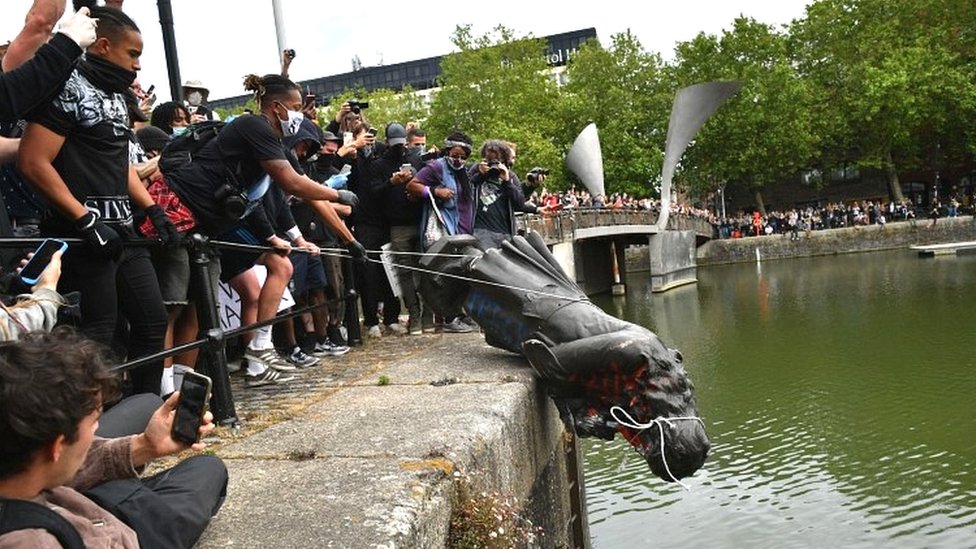
7th of June, 2020, protestors in Bristol topple a statue of Edward Colston and cast it into the harbour
The toppling of the statue of Edward Colston sparked a debate in which the fate of our fossilised forefathers, and more generally the moral gloss with which we treat history, hang in the balance. From the clamour and the chaos that followed the statue’s removal two poles of opinion emerged: those demanding monuments associated with historic injustice be extirpated from our streets, and those defending history as impervious to contemporary moral indictment.
Amid sensational headlines and melees between protestors and counter-protestors I found myself wandering the pretty geometries of Hampton Court’s gardens one late summer afternoon, stumped by the question – how does one carry out an ethical survey of a historical monument? Though I sympathised with protestors’ mission of reckoning with the uglier elements of our history, looking around I was struck by the immense complexity of historical happenstance. The staid and handsome facia that rose before me seemed to belie the manifold chance and causation that had birthed it, and suddenly the thought of distinguishing the moral status of history seemed hopeless, fruitless, perhaps even gratuitous. If we were to subject all our historical architecture and monument to serious moral rigour what could possibly survive? How to disentangle the infinitesimal threads that knot into our history?
So, I fell back on an old philosophical trick: the thought experiment. In cases of some entity or event beguiling classification, it can be helpful to pick two examples that exemplify the particular distinction or division in question. By then examining these two clearer examples, one might distil some crucial element or rule that can then be applied to the tricksy problem at hand, in a sort of reverse engineering of logic. In the case of historical monuments, I landed on:
(i) A hypothetical statue of Adolf Hitler in Berlin
(ii) The Colosseum in Rome
One of these undeniably has no place on public display, (and were indeed purged from German streets in the post-war de-Nazification process), whilst the destruction of the other would be unthinkable, the highest order of historical sacrilege. And yet the Romans carved great swathes into the surrounding European and Middle Eastern civilisations, slaughtering many, taking others as slaves. Today we flock in our thousands every year to marvel at a building erected for the express purpose of ritualistically executing said slaves. So, we have a clear ambivalence when it comes to what we value for public display; history is not granted immunity from moral judgements as demonstrated by our willingness to remove (i) from public display; though we don’t believe all monuments associated with behaviour unpalatable to modern ethics should be removed as demonstrated by our reverence for (ii). It seems the reality lies somewhere between the two sides in the Colston debate, and that each had some degree of truth to their argument.
But what exactly is the essential difference at play here? Are we stuck with both (i) and (ii) or neither? Is it possible to cleanse the cityscape of monuments emblematic of historic racism without sacrificing the totality of our cultural heritage?
Step One: Temporal Proximity
The distinction that first comes to mind between (i) and (ii) is the chasm of millennia that separate them. Paraphrased, the argument might sound something like:
‘beyond a certain point in history injustices should no longer be considered ethical acts, rather purely historical acts’
In a generalised context, this is absolutely true; the Vikings’ famous bloodlust; Genghis Khan’s brutal campaign across the Russian steppes; the proclivity for rape and slave-taking of Golden Age pirates; none of these moral deficits are of particular ethical interest to us. We do not feel compelled to castigate these societies or cultures on the basis of their respective shortcomings and we can celebrate these colourful historical peoples without fear of stepping into murky moral territory.
Problem solved then; we can discard Nazi memorabilia in Germany due to its relative modernity (i) and preserve Roman architecture in Italy due to it being sufficiently ancient (ii). But is the solution so simple? This might suggest that the inhabitants of Renaissance Italy had an obligation to destroy Roman architecture. And besides, where exactly is the line between history and modernity drawn, and why? This answer seems to re-formulate the problem at hand rather than address it, as many on the statue-removal side of the debate see the Colston’s legacy as part of our ongoing history, and those on the statue-preservation side as from a bygone era.
Consider that a pirate outfit is a perfectly innocuous choice for a Halloween costume, but party shops do not stock trans-Atlantic slaver costumes. Temporal proximity is not a relevant differential here; Golden Age pirates were raping and pillaging their way well into the 18th Century, considerably overlapping with the trans-Atlantic slave trade.
So, it appears there is something deeper at play in the case of the slaver and his persistence as a symbol of hatred then, something beyond mere historical closeness, that could help illuminate the core of the problem.
Step Two: Historical Continuum
To my mind, the meaningful distinction between the pirate and the slaver, and by extension the Romans and the Nazis, is their relationship to extant cultures and structures of power. The culture of Golden Age pirates is long dead, and with them any sense of threat or violence that their image might otherwise elicit. Thus, a costume, or a statue, of a pirate is not considered controversial. Equally, Ancient Rome doesn’t find an analogue in modern Italy in that it no longer invades and enslaves its neighbours. Its inhabitants no longer identify as Roman nor do its neighbours identify as Gaels, Thracians or Dacians, who might otherwise feel that the Colosseum stands testament to their enslavement and execution by the Romans. These people have instead undergone multiple cultural transformations and now have robust power structures of their own, namely their respective European states, that stand on more or less equal footing with modern Italy.
In this sense, the Colosseum can be understood as analogous to the figure of the pirate; the moral failings of its creator needn’t preclude their public celebration, as those people who suffered at their hands no longer exist as cultural groups, nor do the historical entities who enacted the suffering exist in any substantive manner. Therefore the Colosseum’s preservation in the public domain does not present an ethical problem.
In contrast, the moral transgressions of the trans-Atlantic slaver have not dissipated into the clouds of history, and effects of chattel slavery and its ideology are still present today. Many argue that black people in white majority countries continue to suffer the aftershocks of the historical injustice they were subject to, although this sometimes what is contested by those on the ‘statue-preservation’ side of the debate – that the racism of the 19th Century does not pervade modern Britain. At the very least, we are encumbered with a deeply ingrained view of race as dichotomous, despite this view having no basis in genetics or anthropology, and this has ensured the perpetuation of the social grouping of those who suffered under chattel slavery and those who enacted that suffering, i.e., the monolith ‘black people’, and corresponding ‘white people’, where there are no more Romans and Visigoths.
In relation to the slaver, the Nazi Party, and Hitler’s role as figurehead, hardly need exposition. The moral failings they embodied, namely anti-Semitism, homophobia, racism, and ableism, are very much contemporary problems and it follows that those who suffered at the hands of the Nazi’s continue to exist as cultural groups. Further still, it isn’t obvious that these groups have since come into power structures of their own that are of comparative magnitude to the forces that meted out, and continue to mete out, their historical repression[1]. Given this, we consider a statue depicting a figure who propagated these prejudices inappropriate for public display.
This explains why so many of us instinctively invoke step one, temporal proximity, as a good rule to explain why certain statues should remain despite the moral ambiguity of those depicted – historical injustices that occurred millennia ago do, as a rule, seem to be of less moral consequence. But this is not by virtue of the time that has since passed, instead it is attributable to a severed thread of power between then and now, which becomes more likely as time passes. If, in the future, the concepts of ‘Jew’ and ‘gentile’ are left behind in the same manner that ‘Roman’ and ‘Thracian’ have been, people may well view Nazi memorabilia with the same moral detachment that we view the Colosseum. In a future where skin colour is given as little significance as eye colour, perhaps chattel slavery will be engaged with as coolly and casually as we do Viking slavery of Anglo-Saxons.
So, Hitler is more akin to the Atlantic slave-trader on account of the perpetuation of the respective discriminatory ideologies of each, and the continued existence of those targeted as cultural ‘groups’ or identities who lack their own comparable structures of power. Therefore, a statue of either should not remain on public display.
Step Three: Architectural Function versus Sculptural Representation
There is another, more physically striking, difference between our two examples – the difference between buildings and statues, and the connotations of publicly displaying either. Statues have the effect of venerating an individual; there is an implicit statement of importance and respect bestowed upon whomever is depicted. It is for this reason that it’s hard to imagine a sculpture of an individual widely reviled ever being displayed, unless it is in a manner carefully devised to contextualise them and the actions that led to their notoriety. This inevitable normative weight of sculpture is amplified when they are displayed publicly; a relevant governing body has esteemed an individual deserving of display and via tax we all tacitly uphold this judgement. Buildings, conversely, are truly historical entities; they are passive, intransitive, defined by whatever we choose to use them for. Take the Cathedral of Syracuse, Sicily, which began as Greek temple in 500 B.C., before it became a Catholic church in the 7th Century, later converted into a mosque in the 9th Century, and finally restored to a church 100 years later. None of these transformations required the destruction of the building’s prior incarnation; the identity of the building always lay in its use. This has been evidenced more recently by the Austrian Government’s decision to repurpose the house Hitler was born in to a human rights training centre for police. The former Reichsbank building, Berlin, that was commissioned by the Nazi Party now houses the German Foreign Office. Neither of these building’s continued use seems egregious, especially when their new functions are so antithetical to the associations we might have with their previous occupants. Buildings do not have the same didactic dimension as sculpture; the Colosseum, although exquisitely designed to dramatise ritual execution, is not an intrinsically bad arrangement of limestone and mortar, and this goes some way further to explain why we would be so loath to dismantle it.
This distinction between building and sculpture, though not relevant when grappling with morally ambiguous historical figures, does establish the boundaries of historical ethical enquiry. We needn’t worry that the historical stratifications of London’s architecture will be one by one excised, having been found guilty of association with some moral failure or other, to be replaced with monochrome, featureless concrete. The ‘where does it stop?’ question has an answer: in depictions of individuals, or otherwise symbols, that signify historical injustices that have persisted to the modern day.
Step 4: Singularity of Symbolism
The final difference to note between our archetypes of monuments is perhaps the most nebulous of them all: what they represent. There is much ambiguity to wade through when considering the symbolism of a given monument, primarily the subjectivity that will be evidenced when asking a number of people what it represents to them. Then there is the dynamism and mutability of an individual’s symbolism – take Julius Caesar for example, purportedly adored by the laymen of Rome but met with deep suspicion from its aristocracy, lionised during the Renaissance for his military prowess and political ambition, but a symbol of tyranny and autocratic over-reach in the Enlightenment. So how to account for this when approaching a monument today? It seems fair to say that our archetypes do hold up to this type of scrutiny; it is hard to imagine celebrating Hitler for anything other than his warmongering and predilection for genocide; Roman culture is undoubtedly broad enough in its aspects not to solely represent their particular brand of cruelty to slaves. So, we can do away with one and keep the other. But the statues that often find themselves the source of controversy are far more liminal than the chosen examples; Confederate Generals have long been cast as freedom-loving patriots by some, as racist zealots by others. Here it gets tricky – calm, open-minded discussion is required. Is an individual’s legacy reducible to a single moral deficit? In most cases, the answer to that question will remain disputed, but it nonetheless parses those irredeemable characters from history’s more ambiguous figures.
Step 5: Application
So, using our two archetypal examples, we have teased out the crucial criteria for the assessment of a monument’s suitability for public display:
Is the monument associated with historical injustice? And if so, do those that suffered that historical injustice continue to exist as a marginalised group? And finally, is the subject depicted reducible to that historical injustice?
If our patinated ancestor answers yes to all those questions they should be removed. To return to the case that set Britain alight with debate, Edward Colston seems to fail on all three counts. His legacy revolves around his hugely profitable involvement in the trans-Atlantic slave trade, which is a subject that reverberates through the politics of today. Although he was known as a benefactor in Bristol, this philanthropism is inextricably entwined with his trading in human life, and he has no other historical achievements that match the scale with which he facilitated the bondage of African peoples. Thus the statue would find a better home on display in a museum where it can be properly contextualised, a sentiment overwhelmingly voted in favour of by the residents of Bristol.
As for other historical figures that have recently come under scrutiny, Winston Churchill, and his likeness in Parliament Square, come to mind. Churchill is a prime example of one of the more morally opaque historical figures; on one hand a resolute war hero, on the other sporting a questionable track record on racial politics. He most notably failed to provide aid during the Bengal Famine of 1943 in which millions of Indians starved. How these virtues and vices are quantified is a hugely complex, perhaps impossible, task. British people and Indian people continue to exist as groups, and thus the possibility of Churchill’s moral failings to be keenly felt do too. However, despite the historical asymmetry in the power dynamic of the two nations, modern relations are of strong partnership. Since Churchill’s day India has grown into one of the world’s largest economies, consistently placing 5th, one place ahead of the U.K. This may be a simplistic metric, but it suggests a process of recovery on the part of India from any historical setback it might have suffered due to the actions of the U.K., and more so that it would no longer be susceptible to such a lopsided power dynamic. Churchill’s veneration does not seem related to his views on race but rather to his war effort, and his character sufficiently diverse not to be singularly reducible to his views on race, nor for celebration of the man to necessitate celebration of these views. Churchill can be lauded as a war hero and used as an example of the UK’s history of racism; one needn’t nullify the other. It is important that neither aspect of his history is left out, and a clearer acknowledgement of his racism would not go amiss.
A more measured approach to emerging cultural battlegrounds such as these so often confirms what most already know but can be difficult to extricate; that there is some truth to both sides of the argument, and that what appear to be polar opposites can in reality find common ground. We needn’t disinter the entirety of our cultural heritage to stand post-humous trial, nor should we sanitise the moral failures of our historical figures.
A Final Note
I believe this last point regarding Churchill was recognised by the BLM protestors in London; Churchill’s statue was not toppled or permanently damaged as Colston’s was, only defaced with the post-script “was a racist”. Perhaps it was a cry for the racist elements in our history to be recognised, not to be destroyed at the cost of our positive history.
[1] the state of Israel is perhaps the exception here, although many non-Israeli Jewish people do not identify themselves with Israel, and thus may not feel empowered or somehow insulated from the effects of anti-Semitism on account of its formation
 The Midnight Review
Leave a comment