
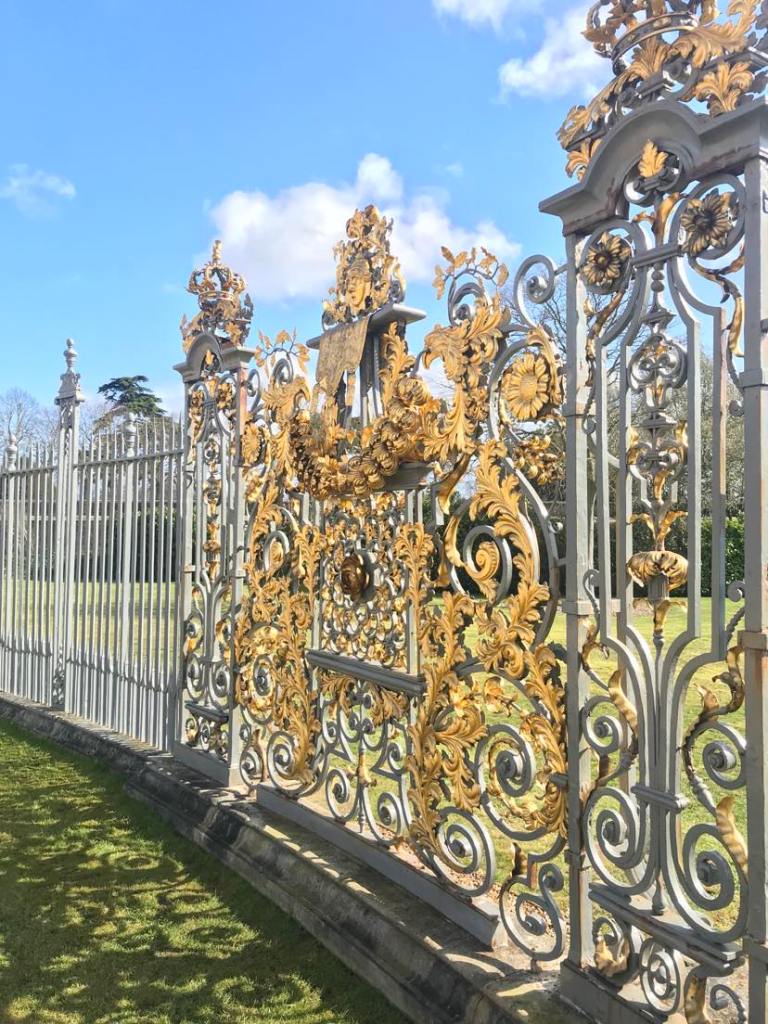
The Tijou Screens at Hampton Court: perhaps the best preserved example of Baroque ironwork in Britain, these screens were installed in the late 17th Century under the supervision of Sir Christopher Wren
Today is a day of finality. We three shuffle over cobblestones and under entablatured archways, all now inured to the historical magnificence of the palace, with eyes only for the security hut and home. Hampton Court had, over the last six months, become simply a place in which we worked.
What never lost their lustre, however, were the gardens. Perhaps it was because of the tide of the seasons, and the gardens’ gentle transformation in response to them, that their palatial luxury was never lost on me. Returning in May after working for a few weeks in the city, what had been a giant skeletal structure of softwood arches in the winter months before, something like a whale’s ribcage, had transformed into a hundred meters of vine-fringed and shade-filled tunnel. The canopy fluttered in the wind and rustled with songbirds, with occasional looking holes showing the sky a faded aerial blue. The neatly manicured lawn was powdered with wildflowers and hummed with bumblebees. Even the grubby old Thames, the artery connecting this little island of history and regency to the grime-spattered fume-filled city that birthed it, was given a healthy sheen by the sun. Enough of an invitation for a swim one day after work.
I did not always feel such a part of the natural landscape of Hampton Court though. By definition, we fought against it. The leafy shrouds and budding wildflowers, the flow of the Thames, and the corrosion of 17th Century ironwork that we battled are all parts of the same whole. And the tools and techniques we used to combat nature were of course not conducive to its unfurling; galvanising spray paint; epoxy primers and lead topcoats; a final finish of linseed oil and turpentine. The many insects that made citadels for themselves between gilt petals and emblems suffered the most heavily. Among us was a consensus to minimise spider deaths, one we arrived at independently from one another, no doubt after individually witnessing the way a spider doused in oil or paint displays a miserable and hopeless act of clinging to life. This manifest in a distressed death-dance of legs frantically and futilely attempting to scrape the noxious, sticky liquid from its eyes, which only serves to encase it yet more, like some horrible parody of a fly in a web. We all went to some lengths avoid spider casualties. But unavoidable was the seduction of nocturnal insects by the linseed oil we sheathed the entire length of the fencing in. Returning the next morning, what had been left a pleasingly rich, glossy grey had become a mass insect graveyard. All manner of flying insects were plastered to the metal, some perishing in the night, others feebly struggling to free their many legs from their viscous incarceration, and like little Promethean souls, each new length of iron was found the next morning a fresh tapestry of mothwings and cranefly carcasses.
I contented myself that the act of preservation of the screens, and the costs to nature incurred in doing so, ultimately represented an improvement in comparison to the manufacture of a new fence. And to coax that magnificent, creaking old bit of metalwork into the the 21st Century was surely a noble cause. So, the flying critters were not Prometheuses, but little Jesuses, crucified across wrought iron so that their future winged brethren might live. Walking out the grand gates for the final time, I was left with an appreciation for the men working either side of me and their willingness to share such a sentimentality with nature where others would not, and a mysterious feeling that the sliver of my life spent in the palace’s gardens had taken on a significance that would only reveal itself in years to come..
 The Midnight Review
Leave a comment