
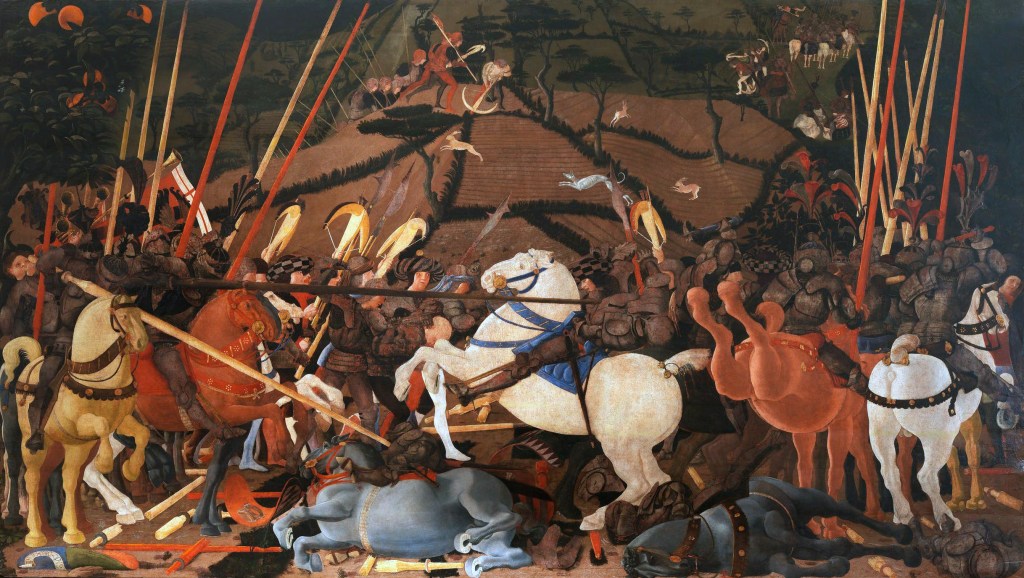
Niccolò Mauruzi da Tolentino unseats Bernardino della Carda at the Battle of San Romano by Paolo Uccello
It is an overcast summer morning on which I arrive at a leafy suburban south-London street. I have been sent to assist the metals restorer with the installation of a brass military plaque, which details a commemorative roll call of those who fought in WWI from a small village in the Midlands. A pretty thing with powdery red and blue wax infills colouring the debossed coat of arms and proud, glossy black lettering across the top. Even in the dull morning light, the brass’ mirror finish has a rich gleam to it. Hal really has done an excellent job. The owner, answering the door, is conspicuously not from the midlands. But the reason for his considerable expenditure restoring the plaque is no mystery having set foot through his front door; every inch of available space of the walls, shelves and floor is adorned with military memorabilia and antiques. The man himself has all the salient features of the standard-issue military collector: un-styled, wild, and wavy hair, an unwaveringly flat voice, dull green and brown clothing faintly suggestive of academia, and spectacles.
Once we had installed the plaque between a WWII recruitment poster and some framed Boer War bullet casings, we engaged in some polite conversation in anticipation of our exit. During this, the collector expressed concern at the prospect of his collection being dispersed once he was no longer around to curate it. Apparently, museums were only interested in the high-value objects, and the rest would be left to diffuse through the invisible network of antique dealers, charity shops, and special interest websites from which they had been gathered. There was the very smallest hint of acrimony in his otherwise uniform drawl when recounting the museum’s selective interest in his collection. This puzzled me. If the Imperial War Museum shows interest in an object you have rescued from the great wilderness of the capital cycle, one would think you had secured it a place in archival paradise. Indeed, it will likely have found its eternal residence, be logged, researched and reported on, luxuriated with climate control and a custom crate, all while waiting its turn to be displayed to enthusiasts in their thousands. But the collector no longer conceived of individual objects, only of the collection, which is sui generis and irreducible. That the museums intended to atomise the collection was akin to being asked to part with the right side of his body. Still, I couldn’t see past the offer for certain elements to transcend their current incarnation in that dimly lit, suburban house.
Reflecting upon this on the drive back to the workshop, Hal suggested that it was the loss of the order of things that was the tragedy the collector faced. And thinking about it, isn’t that what a collector truly pursues in his efforts? A sort of taxonomical perfection in place of the chaotic scattering of objects by time and chance. His chosen category: war, though it could have just as easily been Roman numismatics, Chinoiserie fans, or entomological taxidermy. Certain rarities may be prized additions to the collection, but the value comes from the cohesive neatness of the unity achieved, not its individual constituents. And what of the collector himself? It is his own efforts that bind the collection together. Without him the collection decays back into its mere elements. So, the collecting is a sort of metaphysical mission for order in an otherwise chaotic world, a battle against the universe’s entropy, and the collector ennobled in his efforts to preserve this tenuous harmony. And the natural conclusion? If the value of the collection lies not in the objects themselves but in the relationships between each object, and it is the agent of collecting who begets these relationships, then it is the collector who is responsible for the value of the collection. The collection is the child of the collector, albeit a surrogate parent-child relationship, lacking genetic contribution from the father; he does not create but nurtures. Much like art collectors who endow themselves the titular honour of a gallery. The collection is the collector, exists only because of the collector. But it can also outlive him. As much as the collection is his creation, it also preserves him, like a biological imprint. The Imperial War museum really was asking for him to part with the right side of his body, and the sundering division of his collection via auction after his passing would represent a death as real and meaningful as his first.
 The Midnight Review
Leave a comment